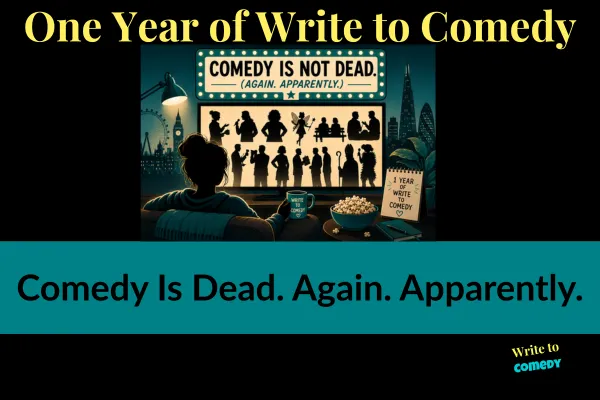
One Year of Write to Comedy. Comedy Is Dead. Again. Apparently.
(Prefer to listen than scroll, here is the audio version of the post. Read by Jacquie Sarah, so expect warmth, humour, and maybe some mistakes.)
On 23 June 2025, I launched Write to Comedy with a plan that sounded completely reasonable at the time.
One blog a week for a year.
A library of posts.
A proper home for all the sitcom thoughts that had been rattling around my brain like an overexcited DVD boxset.
Reader, I did it.
I published a comedy blog every week for a year. I built the library. I wrote about sitcoms, characters, mockumentaries, studio audiences, reboots, finales, old favourites, new favourites, and the things that make comedy work when everybody is convinced comedy is dying. Again.
Am I finished?
Absolutely not.
Am I still publishing weekly?
Also, absolutely not.
That way leads to madness, and I already have enough tabs open in my brain. Write to Comedy will continue, just not at the pace of someone being pursued through a corridor by a commissioning deadline and a very judgemental spreadsheet.
Instead of navel-gazing about what I have learned from writing these posts, because there has been quite enough of that on the internet, I wanted to mark the first anniversary by looking at the comedy that has been around during this first year of Write to Comedy.
Because, despite what we keep being told, comedy has not disappeared. It has not packed a small suitcase and moved to a cottage in the Cotswolds to think about what it has done. It is still being made. Sometimes brilliantly. Sometimes confusingly. Sometimes with the bold confidence of a show that knows exactly what it is. Sometimes with the energy of a programme that has accidentally wandered into the comedy section and is hoping nobody notices.
But it is there.
In the second half of 2025, we had more Not Going Out (see link to post about it below), still doing what it does best on BBC One. We had Here We Go, which remains one of those comedies that understands family life is mostly people interrupting each other in kitchens. We had Daddy Issues, Platonic, Only Murders in the Building, Abbott Elementary, and Mandy, to name a few.
On the subject of Mandy, there was, of course, the curious case of the Christmas special that was advertised and then didn’t appear. It was pulled from the BBC schedule shortly before transmission and moved to 2026, which is the official version. Unofficially, it now lives in the same mysterious cultural cupboard as the 13th episode of Fawlty Towers and the real ending of Stranger Things. Maybe it needed last-minute changes. Maybe Diane Morgan annoyed a wizard. Maybe Mandy herself got a better offer and refused to leave the house. Who knows? I have no clue, which has rarely stopped anyone on the internet.
We also had one-and-done series like Too Much (read post about it below) on Netflix and Film Club on the BBC. We had The Paper (read all about it below), which finally gave us a sort of follow-up to The Office (see post about it below). Not a reboot, not exactly a sequel, but a reminder that mockumentary comedy can still find new corners to peer into with a suspicious camera.
There were also Christmas specials on the BBC for Mrs Brown’s Boys (see post about it below) and Amandaland, which I am sure were great. I didn’t watch them. I am ageing, not heroic. ( I am being facetious, it's a personal choice).
All in all, not a bad time for comedy.
But 2026 has been better.
It started strongly with the third season of Shrinking on Apple TV, which wrapped up its three-season story in a way that reminded us grief and comedy can sit next to each other without one elbowing the other out of the frame. Harrison Ford once again proved he should have been doing more comedy for years, and any appearance from Michael J Fox can elevate an already great episode. Some actors arrive on screen, and the emotional temperature changes. He is one of them.
In January, the BBC gave us Can You Keep a Secret?, starring Dawn French and Mark Heap. It was billed as a sitcom, although it felt more like a narrative comedy with sitcom furniture. I did enjoy it, but I had questions. Mainly: how did two English parents have a Welsh child if they lived for years in a seemingly English village? Details matter to me. I know they shouldn’t. I know I should be able to let things go. I have chosen instead to become this person.
The BBC more than redeemed itself with Small Prophets, which never needed to shout about being a sitcom because it was too busy being strange, lovely, funny, sad, and quietly magical. Mackenzie Crook created a comedy where mythical creatures made more emotional sense than half the realistic drama on television. It had beautifully drawn characters, a real sense of grief and loss, and laugh-out-loud moments that didn’t feel bolted on for safety. (See post below about cosy comedy).
It was the kind of programme that makes you think British comedy still has odd little miracles left in it.
And yes, we are getting more. Maybe only one more series. I’ll take it. Some shows should not be stretched until all the magic leaks out and everyone is standing around wondering why the tiny prophets are now giving brand advice.
Then came the reboots.
Apparently, we could not make it through 2026 without Scrubs and Malcolm in the Middle. To be fair, maybe we couldn’t. Both returned on Disney+ and both had the difficult job of catching the flavour of the originals without simply embalming them and calling it nostalgia.
Scrubs had to deal with the fact that medical comedy has changed, television has changed, and we have all changed. A man daydreaming in a hospital corridor hits differently when the world has recently lived through an actual pandemic. But the revival understood that the heart of Scrubs was never just the cutaway gags. It was friendship, grief, fear, ego, vulnerability, and people using jokes because sincerity is terrifying.
Malcolm in the Middle had an even harder trick. The original was chaos with precision timing. It was loud, weird, clever, and emotionally sharper than it ever got credit for. The revival managed to feel like a return rather than a taxidermy project. The family had aged. The world had moved on. The unfairness remained.
Then there was the biggest comeback of all. Literally.
The Comeback returned for its third and final season, with Lisa Kudrow once again proving why she is one of America’s best comic actors. Valerie Cherish should be unbearable. In the wrong hands, she would be. In Kudrow’s hands, she is excruciating, vulnerable, deluded, desperate, resilient, and somehow impossible not to root for. The new season put Valerie into a Hollywood landscape of AI sitcoms, branding, corporate nonsense, and the endless indignities of being a woman trying to stay visible in an industry that likes women best when they are either young, grateful, or safely iconic.
Valerie is none of those things. She is too needy, too hopeful, too ambitious, too human.
That is what makes her funny.
It is also what makes her tragic.
I wrote a full blog about reboots, which you may wish to read here.
Over on Prime, Last One Laughing went into its second series. Spoiler alert here. Sam Campbell was robbed of the championship by David Mitchell, who somehow was allowed to smile while his peers were eliminated. It made for an ungripping finale. Sam Campbell did have the last laugh (see what I did there), with his absurd new Channel 4 comedy, Make That Movie in May. But we need to go back.
Let’s talk about one of the biggest surprises of the year: Saturday Night Live UK.
This was going to be a flop. Obviously. Countless people pointed this out before it had even aired, which is always helpful. We had tried live sketch comedy before, they said. Britain doesn’t do that format, they said. It won’t translate, they said.
Except we had tried it before. It was called Friday Night Live, and it helped bring Ben Elton and Harry Enfield to wider public attention. Weird for a programme nobody watched.
This time, Sky took the American playbook seriously. Same producer in Lorne Michaels, same broad format, same live energy, first episode hosted by SNL legend Tina Fey, but with British-based talent. It could have been a disaster. It wasn’t.
It was funny.
More importantly, it understood what modern sketch comedy needs to do. It produced clips that could travel on social media without losing the sense that they belonged to a proper live show. It gave performers room to land. It let writers try things. It had confidence.
People begrudgingly admitted it worked, which is perhaps the highest form of British praise.
Then, of course, came the next prediction. Fine, the first one worked. The rest would be rubbish. The rest was not rubbish either.
The hosts were good. The cast was good. The writing found its rhythm. There were people others called standouts, but for me, the strength was the ensemble. They complemented each other, which matters more in sketch than people think. A sketch show is not just a launchpad for whoever shouts loudest in a wig. It needs chemistry. It needs trust. It needs people who know when to take the focus and when to hand it over.
For me, the weakest parts were the political openings. Our politicians are boring. I know that sounds like it should make them easier to parody, but it doesn’t. It makes them beige with a press office. There are only so many jokes you can make about a man in a suit saying nothing in a slightly different way. Once the host appeared, the show usually lifted.
I am glad series two has already been announced. I hope they keep the same team. There is something exciting about watching a comedy format bed in rather than being strangled by panic after three episodes.
And then there was Hacks.
What a show.
Across five seasons, Hacks became one of the best comedies of the decade, and possibly one of the best comedies about comedy ever made. It was not just about stand-up. It was about ego, power, age, ambition, resentment, reinvention, creative dependence, and the strange intimacy that forms when two people understand each other better than is convenient.
At its centre was the relationship between Deborah Vance and Ava Daniels. Calling it a mentor-mentee relationship feels too neat. Calling it a friendship feels too simple. Calling it a love story feels closer, although not in the romantic sense. It was an intergenerational love story between two women who needed each other, hurt each other, sharpened each other, and refused to let each other get away with the easy version of themselves.
Jean Smart gave Deborah glamour, steel, cruelty, fear, brilliance, and loneliness. Hannah Einbinder gave Ava the restless, self-righteous, wounded energy of someone who wants to be good but also wants to win. Together, they were electric.
The final season understood something important: comedy is not just jokes. Comedy is survival. It is control when life is chaos. It is power when the world has underestimated you. It is connection when you cannot say the thing plainly. Deborah’s career was never just a career. It was armour, weapon, addiction, art, and escape route. Ava saw through it because she was building her own version.
The ending worked because it did not pretend either woman was magically fixed. That would have been false. Instead, it gave them movement. A choice. A continuation. The kind of ending that says people do not stop being complicated just because the credits roll.
That is what great comedy can do. It can make you laugh and then quietly rearrange your internal furniture while you are distracted.
So where does that leave the old question: is comedy dead?
No.
Of course it isn’t.
Maybe the traditional studio sitcom is having a wobble. Maybe broadcasters are more cautious. Maybe streaming has made everything more fragmented. Maybe algorithms are now standing in the doorway with a clipboard asking whether your idea has “repeatable emotional engagement.” Maybe some commissioners are too nervous to back something that is simply funny.
But comedy is still being commissioned and made.
I am working on a BBC Comedy at this very moment. Not as a writer. Not yet. Maybe one day. Maybe being adjacent is enough for now. Maybe it is enough to sit near the thing you love and remember it exists beyond theory, tweets, hot takes, and people announcing comedy’s death like they are reading the shipping forecast.
There is still an appetite.
There are still audiences.
There are still writers, performers, producers, editors, directors, crew, accountants, assistants, schedulers, and slightly deranged comedy bloggers keeping the whole thing moving.
So here is my deeply unscientific suggestion. The next time you want background noise, put on a comedy. Even if it isn’t your perfect cup of tea. Even if it is something you only half-watch while making dinner. In the age of algorithms, watching matters. Broadcasters and streamers are not reading our minds. Terrifyingly, they are reading our viewing habits.
Show them you want comedy.
Show them you want more than murder, misery, and people whispering in expensive kitchens.
Maybe the next year in comedy will be even better.
Maybe these written pieces will find a home on a bigger platform.
There have been bigger plot twists.
For now, thank you. If you have read all of these posts, you deserve a medal, a lie down, and possibly a commissioning role. If you have read one or two, thank you as well. You have made an ageing, jaded comedy geek very happy.
Write to Comedy is one year old.
The library is built.
The door is still open.
I’m just not publishing every week anymore, because even sitcom characters get a series break.
Do you have a favourite post this year? Do you have a suggestion for a new post? Let me know here.
Articles mentioned in this post:
Not Going Out: Putting the Sit in Sitcom Since 2006
Not Going Out might not win awards, but it’s won our hearts. Here’s how Lee Mack’s old-school sitcom keeps staying funny after 100+ episodes.
Fat Characters and Fat Jokes. Why We Need to Get Over Ourselves
From Fat Monica to Mr Bigstuff, comedy has a long history of fatphobia. Here’s why fat characters deserve better — and how TV can write them with dignity and humour.
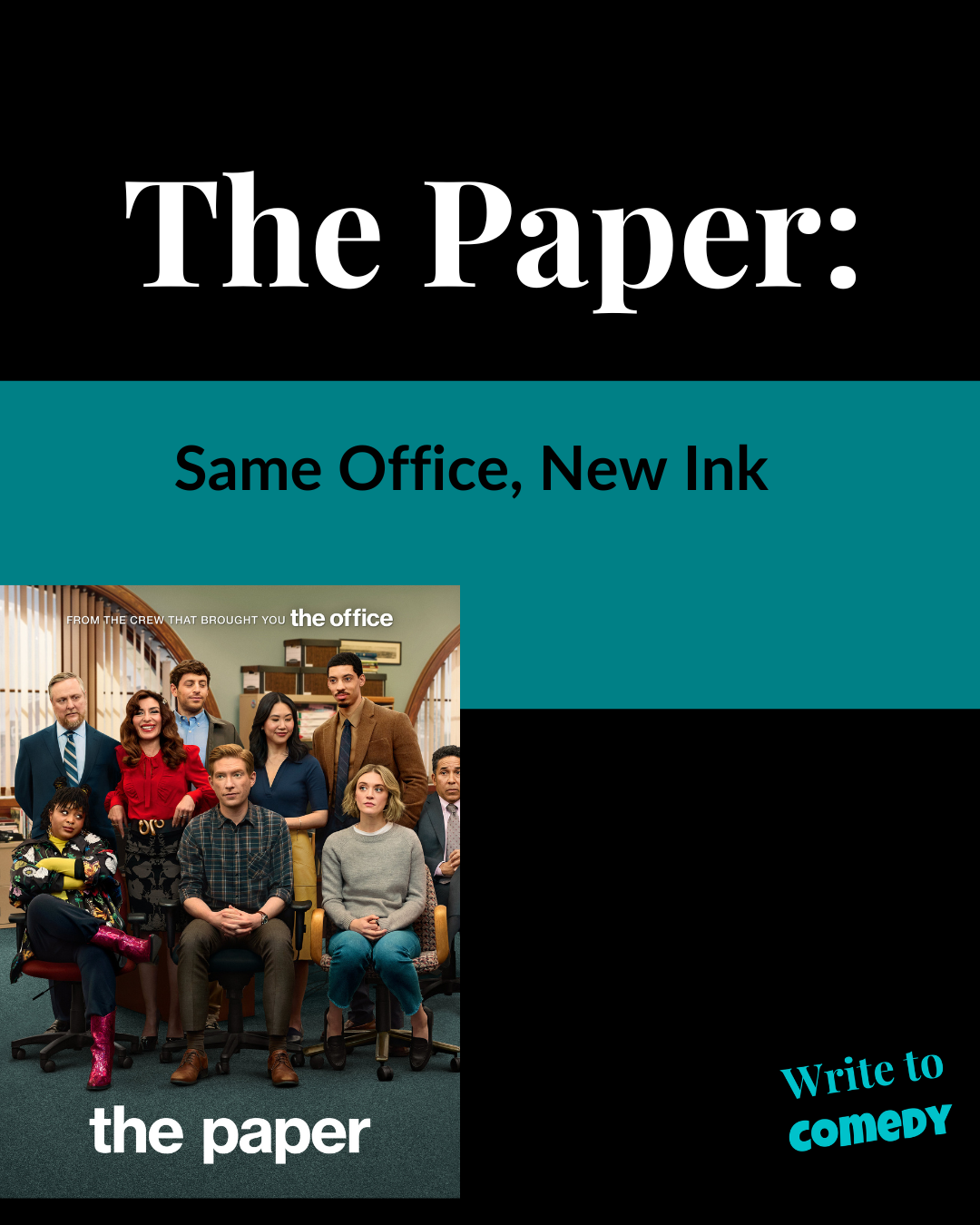
The Paper: Same Office, New Ink
The Office isn’t dead—it’s just moved to Toledo. Greg Daniels’ The Paper brings back the mockumentary magic with heart, wit, and fresh chaos.
The Failure and Success of The Office (US) And What I (We) Can Learn From It
How The Office (US) went from flop to phenomenon — and what its messy, miraculous journey can teach us about creativity, failure, and finding your voice.
Leave Mrs Brown’s Boys Alone: The Case Against Comedy Snobbery
Mrs Brown’s Boys isn’t perfect — but mocking those who love it misses the point. Here’s why comedy snobbery is the real joke.
Why Some Sitcoms Feel Instantly Cosy (And Others Feel Like Work)
Why do some sitcoms feel like a warm hug while others feel emotionally exhausting? From Small Prophets to BoJack Horseman, a look at comfort comedy, tone, and what we want from TV now.
Reboots, Revivals, and TV’s Favourite Habit: Coming Back Like Nothing Happened
Same cast, same characters, twenty years later. Sitcom revivals are booming, but are they better than reboots or just nostalgic comfort TV?