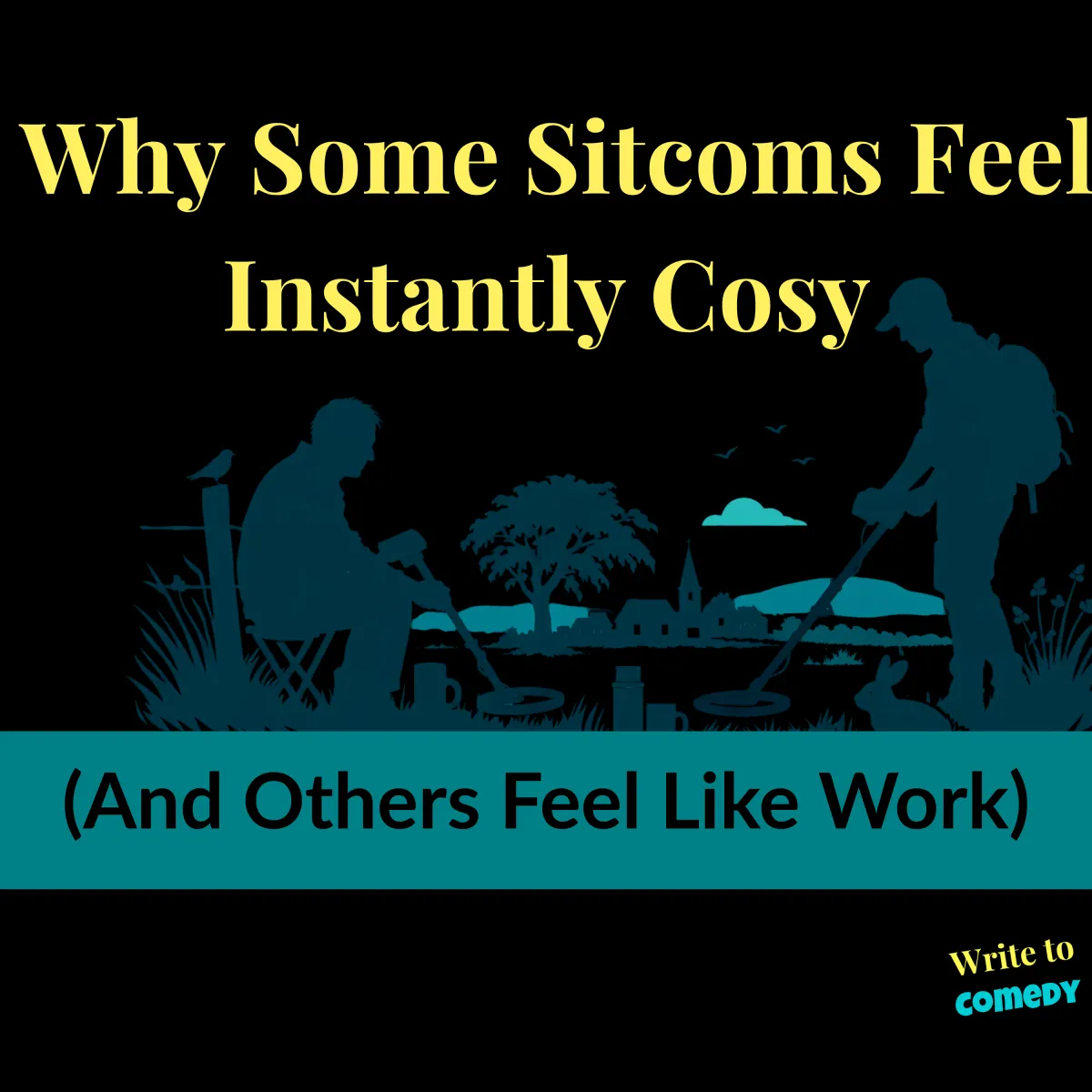
Why Some Sitcoms Feel Instantly Cosy (And Others Feel Like Work)
(Prefer to listen than scroll, here is the audio of the post, Human voice, not AI)
There are some comedies you put on because you want to laugh.
There are others you put on because you want to feel emotionally winded by a programme that is, technically, still filed under comedy.
Both are valid.
But they are not the same experience.
This is the thing people often miss when they talk about comedy as though it is all doing one job. It isn’t. Some comedy is comfort. Some is confrontation. Some is gentle companionship. Some is a brilliantly written spiral into pain with a few jokes scattered through it, so you do not realise until later that it has quietly ruined your evening.
And that does not mean one is better than the other.
It just means that sometimes you want something warm, human, and oddly life-affirming. And sometimes you accidentally put on a comedy that leaves you staring into the middle distance like a Victorian widow.
The difference between cosy and “critically acclaimed but I need a lie down after”
When I say a sitcom feels cosy, I do not mean slight. I do not mean soft in a dismissive way. I do not mean lacking ambition, bite, or intelligence. I mean it creates a sense of emotional safety.
That safety can come from lots of things. Familiar rhythms. Kindness between characters. Low-stakes worlds. A sense that even when life is messy, the show itself is not trying to batter you over the head with despair and call it sophistication.
That is why Small Prophets feels like such a useful example.
Mackenzie Crook’s 2026 BBC comedy follows Michael Sleep, a man whose wife vanished years earlier, who is caring for his elderly father, drifting through a life that has quietly collapsed around him, and who forms an unexpected friendship with his much younger colleague Kacey. It is sad. It is strange. It has loss running all through it. And yet it feels warm rather than punishing. Hopeful rather than manipulative. Odd, but never smug about its oddness.
That matters.
Because Small Prophets proves something important. Cosy comedy does not have to mean there is nothing at stake. It just means the show understands that sadness is not the same thing as brutality.
Cosy comedy says: come in, sit down
Comfort comedy tends to have a few things in common.
First, the world feels inhabited. Not just written, inhabited. You believe these people existed before the pilot and will continue after the credits. Their lives feel ongoing. You are not just watching plot. You are dropping in.
Second, the conflict is manageable. That does not mean there is no tension. It means the tension is not so relentless that you feel as though the programme is trying to test your emotional endurance.
Third, there is warmth. Not sentimentality necessarily. Warmth. Those are different things. Sentimentality begs you to feel. Warmth earns it.
Small Prophets has that warmth. So did Detectorists. The details are different, but the sensibility is related. Crook seems interested in people who might easily be overlooked by louder shows. People carrying quiet disappointment. People still fumbling towards connection. People with odd interests, odd rhythms, odd lives, and no desire to become cooler for television. The Guardian explicitly linked Small Prophets to what Detectorists fans love about Crook’s work, which feels fair.
That is part of what makes a comedy feel cosy. The show respects its own people.
It does not sneer at them.
It does not punish them for caring.
It does not confuse cruelty with edge.
Then there are the shows that are brilliant and also a bit of an ordeal
Now we move to the other end.
These are the comedies people recommend to you with a faintly evangelical air.
“You have to watch it.”
“Is it funny?”
“Yes, but also devastating.”
“Right. Good chat.”
This is where shows like BoJack Horseman and Barry live for me. They are funny, sometimes ferociously so, but they are not comfort shows in the traditional sense because they demand more from you.
Emotionally, certainly. Morally, sometimes. Structurally, too.
BoJack Horseman starts out looking like an offbeat animated satire and then becomes a show about damage, self-deception, addiction, ego, trauma, and the long miserable echo of being a person who knows better and still gets things wrong. It is clever, inventive, and often brilliant. It is also not what most people reach for when they are knackered and want to feel better about humanity.
Barry does something similar in a different key. It takes comedy and keeps feeding it into violence, absurdity, dread, and moral collapse. Again, excellent. Again, not cosy unless your ideal bedtime routine is psychological unravelling.
These are not shows you gently settle into. They want your attention. They want your discomfort. In some cases, they actively feed off it.
And that is fine. That is what they are built to do.
So what makes a comedy feel like work?
It is not just darkness.
Dark comedy is not automatically hard work. Nor is light comedy automatically comforting. A comedy can be bright and still feel exhausting if it is shrill, emotionally false, or so desperate to prove how clever it is that you end up admiring it in the way you admire a very competent dentist.
A show starts to feel like work when the act of watching becomes effortful.
Maybe the tone is relentlessly tense. Maybe everyone is emotionally sealed off. Maybe the humour relies on sustained discomfort with no release. Maybe the story keeps escalating in ways that are impressive but draining. Maybe the show does not trust quietness, so every moment has to be underlined, heightened, sharpened, pushed.
Or maybe the show is simply asking you to sit in pain longer than you feel like sitting there that day.
That does not make it bad. It makes it demanding.
There is a difference.
I think sometimes we have become a bit too eager to assume that if a comedy leaves you flattened, it must automatically be more important than one that leaves you soothed. But that is just snobbery with better lighting.
Making something feel easy is not easy.
Making something gentle without making it dull is not easy.
Making a viewer feel safe enough to exhale is not easy at all.
Small Prophets and the case for gentle comedy now
This is why Small Prophets is such a useful recent example.
It is not cosy because nothing bad has happened. Quite the opposite. Michael is carrying grief, uncertainty, loneliness, and the half-life of abandonment. His father is elderly. His friendship with Kacey comes out of a life that has narrowed. None of that is trivial. But the show still gives you room to breathe. It understands melancholy without wallowing in it. It understands strangeness without making it alienating. It trusts small gestures and quiet hope.
That balance is hard.
A show like this can tip into twee if it is too pleased with its own whimsy. It can collapse into mush if the characters are vague. It can become irritating if the emotional stakes are too underplayed. But when it works, it feels like television made by someone who understands that not every meaningful story has to leave scorch marks.
That, to me, is a huge part of cosy comedy. It does not deny pain. It just does not make pain the entire architecture.
We do not always want to be challenged at 9pm
Part of this is also about how people actually watch television now.
Life is tiring. The world is loud. Most people are overstimulated, under-rested, and one badly timed email away from wanting to live in a shed in the woods.
So when people choose a comedy, they are not only choosing what is funny. They are choosing what kind of emotional experience they can manage.
Sometimes you want a show that says, “Look at this damaged man destroy himself and everyone around him, but with impeccable writing.”
Sometimes you want a show that says, “Here are some decent, odd people trying to get through.”
Those are different needs.
And that is why the phrase “comfort show” matters. It is not code for mediocre. It is code for rewatchable, regulating, reassuring. It means the show has become part of somebody’s emotional furniture. Something they live with. Something they return to. Something that helps.
That is not lesser television. That is useful television.
Frankly, it may be the more generous achievement.
Cosy does not mean consequence-free
One thing I do not want to suggest is that comfort comedy has no depth.
It often does. In fact, some of the cosiest comedies are quietly devastating in places. But they understand modulation. They know when to press and when to release. They let sadness sit alongside absurdity. They do not confuse emotional honesty with emotional bludgeoning.
That is what makes them feel humane.
Small Prophets works because it has sadness in it, but not contempt. Loss in it, but not hopelessness. The same was true of Detectorists. It is true of Mum. It is true of Gavin and Stacey at its best. It is true of shows that understand ordinary life is already hard enough without turning every episode into a referendum on despair.
The best cosy comedies know viewers can handle pain.
They just do not make pain the whole event.
So where does that leave us?
Probably with a very obvious answer.
Some sitcoms feel instantly cosy because they create emotional safety, tonal trust, and a world you want to return to. Others feel like work because they are asking more of you: more attention, more discomfort, more moral stamina, more willingness to be unsettled.
Neither approach is wrong.
But they are not interchangeable.
And I do think we do ourselves a slight disservice when we pretend the second category is automatically more worthy. Sometimes the greatest achievement in comedy is not making us gasp at how dark, daring, or formally clever something is.
Sometimes it is making us feel better.
Sometimes it is building a world we want to go back to.
Sometimes it is proving that British television can still make comedy with softness, patience, and heart without it feeling flimsy or old-fashioned.
Sometimes, in other words, it is Small Prophets.
And honestly, that may be the bigger miracle.
Agree? What is your favourite new comedy of 2026 and why is it Small Prophets? Let me know by clicking here.
You may also like:

Why I Love Comedy (And I am Not Sorry)
Comedy isn’t just funny. It’s connection, comfort and clarity. A personal reflection on why it matters.
The Vicar of Dibley: Curly Wurlys, Kindness and a Quiet Comedy Revolution
Why The Vicar of Dibley still works: character, context, controversy and Curly Wurlys in one of Britain’s most beloved sitcoms.
Victoria Wood: The Standard We’re Still Trying to Reach
Ten years after her death, Victoria Wood’s influence on British comedy is still unmatched. A personal reflection on her work, her writing, and why we’re still trying to catch up.
Read more blogs by clicking here.
Comedy Through the Cracks
A free exclusive PDF essay.
If life keeps cracking at the edges, you might as well laugh at the draft. Comedy Through the Cracks is my short, honest take on why comedy endures — and why we need it when we’re one awkward moment away from combusting.
Download it here to remember why humour endures (and why we need it more than ever).