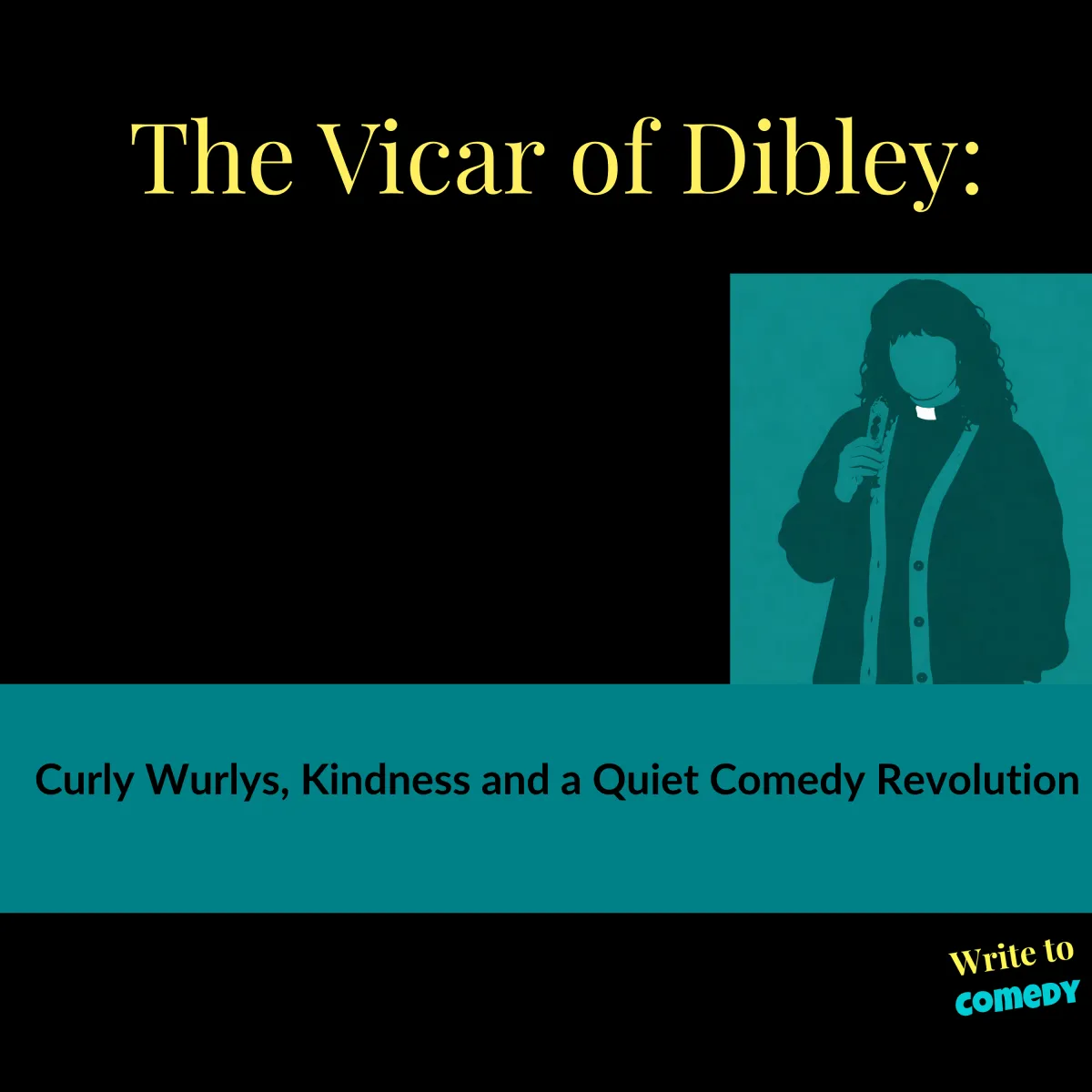
The Vicar of Dibley: Curly Wurlys, Kindness and a Quiet Comedy Revolution
(prefer to listen than read? Here is the audio version of the blog.)
There are sitcoms you admire. There are sitcoms you analyse.
And then there are sitcoms you just… settle into like a Sunday afternoon you didn’t know you needed. The Vicar of Dibley is firmly in that last category. Cosy, warm, quietly radical, and somehow still sharper than people give it credit for. And clearly, I am not alone. On That TV Comedy Podcast, this episode is the most downloaded by a mile. Not just a polite lead. A landslide. This was against programmes, like The Office, Brooklyn Nine-Nine, and Friends. Which tells you something straight away. People don’t just like Dibley. They return to it.
Context First, Because It Matters
Before we get into Curly Wurlys and Christmas lunch misunderstandings, we need to talk about timing.
The Vicar of Dibley (written by Richard Curtis and Paul Mayhew-Archer) arrived in 1994, right on the heels of the Church of England allowing women to be ordained as priests for the first time. This was not universally embraced. It was controversial, debated, and for some, outright unacceptable.
Which makes the existence of Geraldine Granger even more interesting. Because she isn’t written as a political statement. She’s written as a person. And yet, the show itself is a statement. Just not a shouty one. Dawn French reportedly received death threats for taking the role. Think about it for a second. A sitcom. About a vicar. With a love of chocolate. And people lost their minds.
Comedy has always been a battleground. Even when it’s wearing a chunky knit and making tea.
Geraldine Granger: Not Just “Nice”
On paper, Geraldine shouldn’t work as a sitcom lead.
She’s kind. She’s decent. She’s… well, nice. And “nice” is usually code for “not funny”.
Dawn French knew that. It’s one of the reasons she was hesitant to take the role. She didn’t want to be the straight character surrounded by eccentrics. Thankfully, the writers had other ideas.
Geraldine is flawed. Endearingly, painfully flawed. She’s too nice, often to her own detriment. She wants to be liked. She overcommits. She avoids confrontation until she absolutely can’t.
She is also:
·A committed chocoholic (Curly Wurlys doing some heavy lifting here)
·A hopeless romantic
·Someone who occasionally makes terrible decisions for very human reasons
That balance is everything. She’s not the straight character. She’s the emotional anchor in a world that refuses to behave normally. And that is far more interesting.
A Comedy of Partnerships (and Absolute Chaos)
If Geraldine is the heart, the village is the engine. And what an engine.
Dibley is built on partnerships. Not in a neat, sitcom-pairing way. In a slightly chaotic, deeply British, “we are stuck with each other forever” way.
Geraldine and Alice – the emotional core. Warm, absurd, occasionally baffling.
David and Hugo – control vs awkwardness, power vs politeness.
Hugo and Alice – a romance so unlikely it somehow becomes inevitable.
Frank and Jim – chaos merchants, with Jim’s “No no no no no… yes” doing Olympic-level comedic timing.
Owen and… his cows – look, someone has to represent the agricultural community.
This is where the show quietly excels. No one is disposable. Every character has a rhythm, a voice, and a place in the ecosystem. And it’s a proper ensemble. Not “here are the side characters”. More “this village would collapse without every single one of these weirdos”.
Structure, But Make It Flexible
One of the most interesting things about The Vicar of Dibley is how it refuses to behave like a neat, consistent sitcom.
Yes, it starts traditionally enough:
Series 1: 8 episodes, 30 minutes
Series 2: 4 episodes, 30 minutes
Then it starts stretching:
Series 3: 4 episodes at around 40 minutes
Later series: drifting into 45, 50, even 60-minute specials
And that shift matters. Because the show earns the longer runtime. It leans into bigger emotional arcs, more expansive storytelling, and episodes that feel more like events than instalments.
It’s not quite a sitcom. Not quite a comedy drama. It sits in that lovely in-between space where British television does its best work.
The Joke Structure That Shouldn’t Work (But Does)
Let’s talk about the running gag. The joke between Alice and Geraldine.
A simple setup. A misunderstanding. A punchline that takes its time. Alice simply refusing to understand, making it far more complicated than need be.
It’s often placed right at the end of the episode, doing the job of being the final punchline. The same punchline, every week. Just told in a different way. Which is odd. Structurally, it shouldn’t work as well as it does.
But it becomes a rhythm. A ritual. A little contract with the audience.
Other highlights include (including links - if I can find them:
You remember Jim’s catchphrase? No, no. no, no, yes.
Or Frank, the most boring man in Dibley’s history, comes out on a radio show that no one but the vicar hears.
Or Alice dressing as David Tennant’s Doctor Who for Geraldine’s Wedding.
Or, I could go on and on. There are so many funny moments.
When Cosy Gets Political
For a show often described as “cosy”, Dibley wasn’t afraid to poke at bigger ideas. The most notable example being the Happy New Year (2005) episode and its Make Poverty History ending. The beginning had the joke between Alice and the Vicar instead of its traditional wrap-up. The end of the episode shifts tone. The cast appear with banners supporting the campaign. Real-world footage follows. The comedy pauses, and the message takes centre stage.
Reactions were… mixed. Some found it powerful. Others thought it was heavy-handed and tonally jarring. So much so that later broadcasts trimmed the ending entirely. UKTV Gold, for a time, cut it off early and rolled credits instead. If you want the full version now, you can still find it on ITVX.
It’s a fascinating moment. Because it asks a bigger question: How far can a sitcom stretch before it stops being a sitcom?
Comic Relief, Comebacks, and the Reality of Time
Dibley never fully disappeared. It popped up in Comic Relief specials over the years, often leaning into its own legacy while giving audiences a quick return to Geraldine.
And then came 2020. The lockdown specials. Short, Zoom-style episodes designed to offer comfort during what can only be described as a collective nightmare.
The intention was right. Genuinely. But the reality? Not quite the same.
With much of the original cast gone and the format restricted, it lacked the chemistry that made the show what it was. As of now, Dawn French and James Fleet are the only main cast members still with us.
It’s a reminder of something sitcoms don’t like to admit. They are fragile. Built on timing, chemistry, and a very specific moment in time.
You can revisit them. You can’t always recreate them.
So… Should There Have Been More?
Yes.
And no (no no no.)
There was absolutely an appetite for more Dibley. Audiences loved it. Still do. But behind the scenes, things were shifting. Richard Curtis was moving deeper into film. Schedules got complicated. Getting that core cast together became harder.
And maybe, quietly, it stopped at the right time. Because what The Vicar of Dibley leaves behind is remarkably intact.
A show that:
Took a controversial real-world issue and made it human
Built one of the most loveable ensembles in British comedy
Balanced warmth with actual comedic craft
And gave us a lead character who proved “nice” doesn’t mean boring
Final Thought (and a Big Knitted Jumper)
There’s a reason people keep coming back to Dibley. It’s not just nostalgia. It’s not just comfort.
It’s because underneath the tea, the jokes, and the slightly chaotic parish meetings, there’s something very precise going on.
Character-first comedy.
Real stakes, even when they’re small.
And a deep understanding that kindness, when written properly, is not soft. It’s powerful.
Also, never underestimate the comedic value of a Curly Wurly.
Or a woman in a big jumper quietly changing the world.
Agree or Disagree? Have I missed the best part of Dibley? Let me know what you think by clicking here.
You may also like:
Each episode, sisters Amanda Davies and Jacquie Sarah take turns choosing a TV comedy series, breaking it down with an emphasis on a specific episode, and generally geek out about it.
Top Ten Female Sitcom Characters of All Time (the Brit Edition)
Last year I wrote a blog for the Bang2Write website called Top Ten Female Sitcom Characters. Fair criticism: my original list leaned heavily American. But there’s a reason for that - British sitcoms haven’t historically given women the spotlight, especially not in leading comic roles.
An in-depth look at the magic of Gavin and Stacey — its origins, characters, Welsh setting, finale, and why it became one of Britain’s most loved sitcoms.
Read more posts by clicking here.
FREE DOWNLOAD
Comedy Through The Cracks - A short essay
Grab your free exclusive download here.