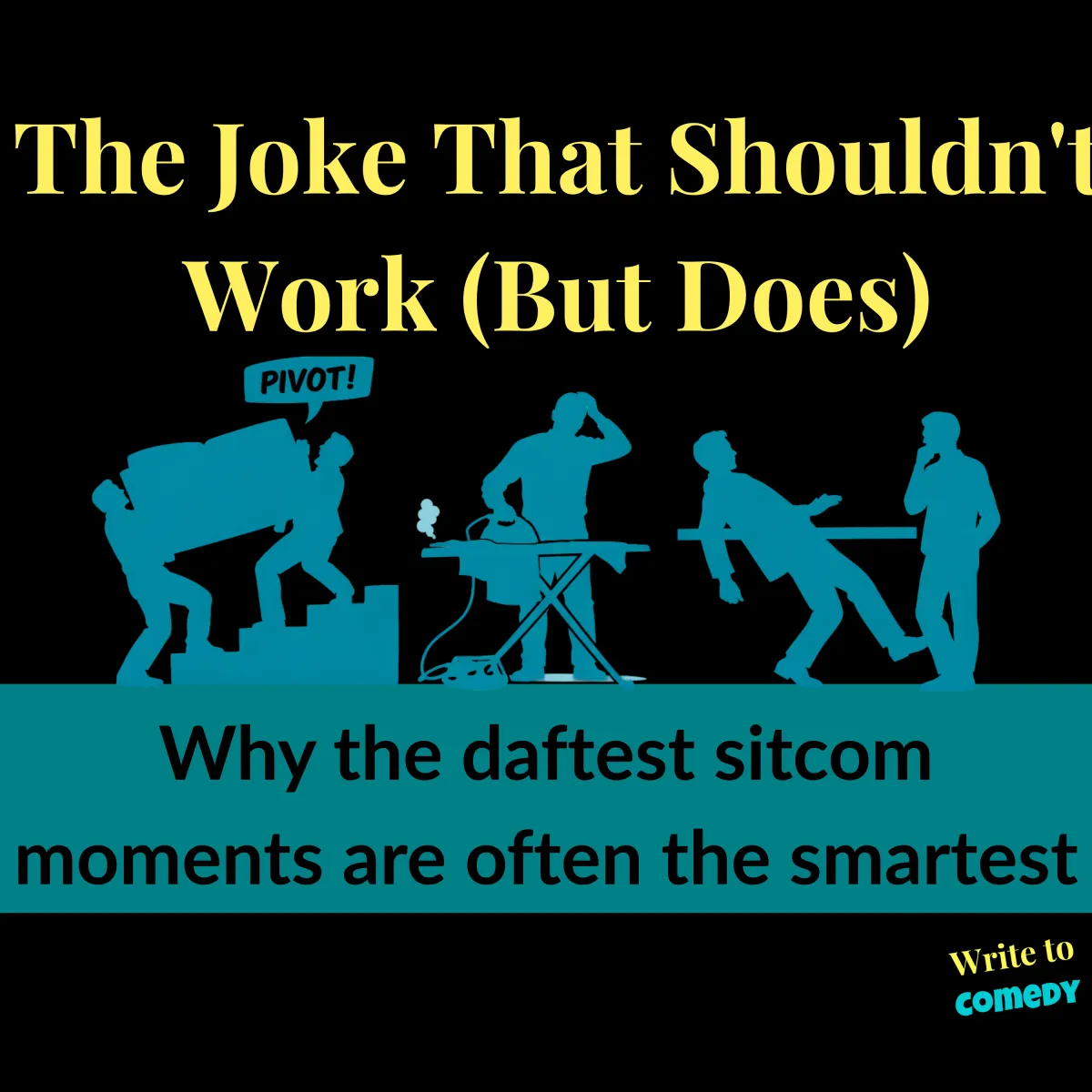
The Joke That Shouldn't Work (But Does): Why the daftest sitcom moments are often the smartest
(Prefer to listen than scroll, here is the audio of the post. Human voice, not AI)
Some of the funniest moments in sitcom history sound absolutely ridiculous when you write them down.
A man keeps shouting “pivot” while trying to get a sofa up the stairs. A posh man attempts to iron his trousers and ends up in a full silent war with domestic appliances. A market trader leans on a bar that is not, in fact, there. A bored office worker says very little at all, but one look to camera somehow finishes the joke better than a paragraph of dialogue ever could.
On paper, none of this should be especially clever. In some cases, it should not work at all. If you pitched “man struggles with sofa” as the centrepiece of a sitcom scene, there is every chance somebody in development would blink at you, tap the page, and ask whether there was anything a bit more sophisticated on the way.
And yet these moments land. More than that, they last. They become the bits people remember, quote, gif, shout at actors in the street, and wheel out twenty years later as proof that comedy can be both stupid and brilliant at the same time. David Schwimmer has said people still yell “pivot” at him now, which is both a testament to sitcom immortality and surely an exhausting way to buy milk.
So why do jokes that sound daft on paper feel so smart on screen?
Because comedy was never only about punchlines. It is about behaviour. It is about pressure. It is about character. And, annoyingly for those of us who like to think writing is the whole game, it is also about performance.
Take the “pivot” scene in Friends. It appears in season five’s “The One with the Cop”, and stripped to its bones, it is a very simple idea: Ross buys a sofa and refuses to accept that physics has opinions. He orders Rachel and Chandler to help him manoeuvre it up a narrow stairwell, repeatedly yelling “pivot” as if volume might somehow alter geometry. That is the joke. There is no elegant wordplay. No killer one-liner. No satirical insight into late capitalism. Just a man, a sofa, and mounting idiocy.
But it works because it is not really about the sofa. It is about Ross.
Ross does not behave like a normal human being trapped in a minor inconvenience. Ross behaves like a man leading a military campaign that history will vindicate. The joke is funny because his certainty is so wildly out of proportion to the situation. He is not just wrong. He is wrong with authority. The repetition of “pivot” gets funnier because the confidence never drops, even as the plan visibly dies in front of him. That is not a line-based joke. That is behaviour under pressure.
The same is true of Niles in Frasier. In “Three Valentines”, David Hyde Pierce spends much of the opening sequence alone, trying to get ready for a date while everything that can go wrong does go wrong. It begins with an irritation over the crease in his trousers and escalates into one of the great pieces of sitcom physical comedy, involving scissors, an iron, a fire, a fainting spell, and total social annihilation before he has even left the flat. Very little of it depends on dialogue.
Again, this is not funny because “trousers” are inherently comic. It is funny because Niles Crane is the exact man for this disaster.
A less precise character might simply look flustered. Niles makes panic look choreographed. His whole identity is wrapped up in control, refinement, and ritual, so watching that machinery fail is funny in itself. He is still trying to maintain dignity while the universe sets fire to his trousers. The scene works because it is exquisitely true to character. The joke is silly. The character logic is airtight.
That is usually the difference.
When a joke feels stupid in a bad way, it is often because it could belong to anyone. It is random. It has no roots. It is a comic event dropped onto a character rather than something growing directly out of who they are.
When it feels stupid in a good way, the behaviour is so specific that it could only happen to this person, in this moment, in this show.
That is why physical comedy, when it works, often feels smarter than many verbal jokes. It is not just movement. It is character made visible.
Think of Del Boy falling through the bar flap in Only Fools and Horses. If you describe it coldly, it is broad. Man leans. Man falls. Audience laughs. But Del Boy is not just any man and this is not just any fall. He is performing confidence. He is selling himself. He is leaning into his own image of effortless cool, and the world literally drops away beneath him. The joke is physical, yes, but the reason it lands is status. The fall punctures the performance he is trying so hard to maintain. That is why it sticks.
And then there are jokes that barely count as jokes on the page at all.
This is where The Office becomes useful. Some of its funniest moments are not punchlines but reactions. Tim’s look to camera is now so familiar it almost feels built into the grammar of modern comedy, but it works because it completes the scene’s emotional logic. Gareth says something absurdly self-important, Brent humiliates himself again, office life continues its slow death march, and Tim gives the audience the one thing they desperately need: recognition. He is not telling a joke. He is registering one on our behalf.
That matters, because it gets at something sitcom writing can forget when people become obsessed with being “clever”.
Cleverness is not always the thing.
Sometimes the smartest move a comedy can make is to stop trying to sound witty and let the situation breathe. Let the character reveal themselves. Let the rhythm do some work. Let the audience join the dots instead of hitting them over the head with a line that knows it is funny.
This is why some very simple jokes endure while some technically impressive ones evaporate the second the episode ends.
You can admire a clever line. You can even envy it, which is always fun in a deeply corrosive sort of way. But behaviour-based comedy gets under your skin. It lives in the body. You remember how it moved. You remember the pause before the disaster. You remember the face someone pulled when their dignity left the room without them.
That is also where actors come in, and we should be honest about that.
There are jokes that read fine and die in performance. There are also jokes that look impossibly slight on the page and become iconic because the actor understands exactly how seriously to take the nonsense.
David Hyde Pierce is a perfect example of this. So is David Schwimmer, for that matter. Neither of those scenes works if the actor is nudging the audience as if to say, “Look at me doing a funny bit.” They work because the performers commit completely. Ross truly believes he can solve the sofa situation. Niles truly believes he can restore order. Comedy does not survive contempt. The actor has to play the reality of the moment, not the idea of being amusing.
That is why “stupid” jokes can feel smart. Not because they are secretly intellectual puzzles in disguise, though sometimes people do like to reverse-engineer them afterwards and call it analysis. No, they feel smart because they are precise. The writing knows the character. The performance knows the stakes. The scene escalates properly. The rhythm is exact. The behaviour is truthful, even if the situation is absurd.
In other words, the joke is not clever because it sounds impressive when written down. It is clever because everything holding it up is doing its job.
And that, irritatingly enough, is a much harder thing to pull off.
Anyone can write “man falls over”. Plenty do. The trick is making us feel that this particular fall could only belong to this particular person. The trick is making repetition funnier rather than merely repetitive. The trick is understanding that comedy is not just built out of lines but out of status, tension, rhythm, and behaviour.
Which is probably why so many great sitcom moments look faintly idiotic when summarised.
A good joke often does.
From a distance, it can seem flimsy, childish, too broad, too obvious, too small. But then the right character steps into it, the right actor commits to it, the pressure tightens, and suddenly something that should not work at all works perfectly.
That is not an accident. That is craft.
And perhaps that is the real comfort for comedy writers. If a joke sounds a bit stupid on paper, that does not automatically mean it is bad. It may just mean it has not become fully itself yet. It may be waiting for character, timing, staging, and performance to turn it from “What on earth is this?” into “Fine, yes, that is genius.”
Which, come to think of it, is true of quite a lot of sitcom.
Agree? What's your favourite funniest moment? Let me know by clicking here.
You may also like:
Ten Sitcoms Every Comedy Writer Should Watch (Plus Three I Couldn’t Leave Out)
If you want to write comedy, start here. Thirteen shows that changed the rules and what you can steal from each one.
Nearly Not Funny: The Sitcoms That Were Rescued at the Last Minute
From failed pilots to major rewrites, this explores how iconic sitcoms like Seinfeld and The Office were rescued, and what writers can learn from it.
Too Smart to Laugh? Are We Too Media Literate for Sitcoms Now?
Have audiences become too media literate for sitcoms, or are writers just getting lazier? A sharp look at modern comedy, AI, revivals, and why familiar still works.
Read more blogs by clicking here.
Comedy Through the Cracks
A free exclusive PDF essay.
If life keeps cracking at the edges, you might as well laugh at the draft. Comedy Through the Cracks is my short, honest take on why comedy endures — and why we need it when we’re one awkward moment away from combusting.
Download it here to remember why humour endures (and why we need it more than ever).