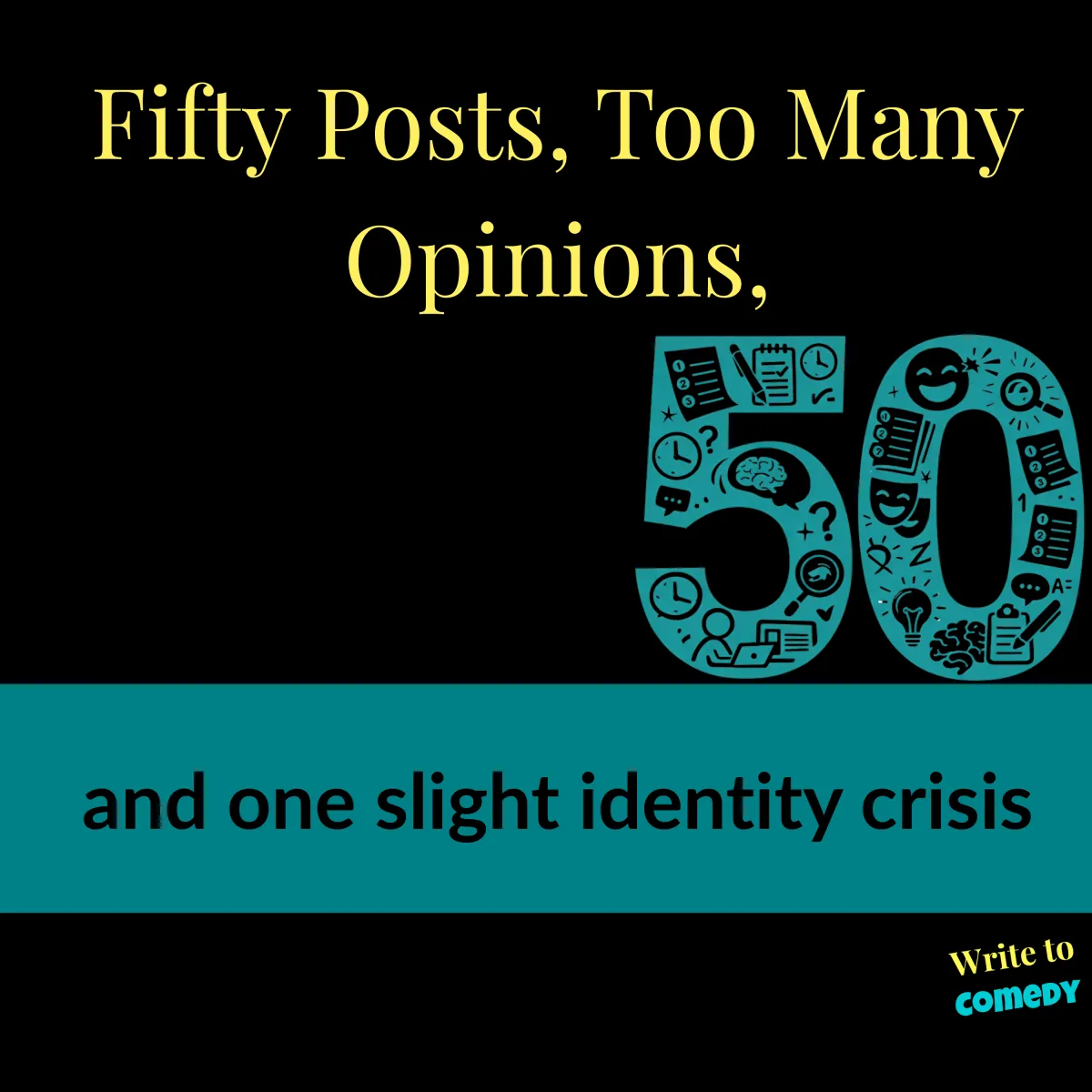
Fifty Posts, Too Many Opinions, and One Slight Identity Crisis
(prefer to listen than read? Here is the audio version of the blog.)
Last month, I hit fifty posts. It feels like both an achievement and a cry for help.
When I started Write to Comedy, I thought I knew exactly what it was going to be. Neat. Structured. Sensible. Posts about how sitcoms work. Clear takeaways. Maybe a diagram if I felt like it. If I could include a colour coded spreadsheet, all the better. Instead, what I’ve actually created is… this.
A mix of top tens, cultural deep dives, mild rants, quizzes, personal essays, and the occasional existential wobble about whether I even like comedy anymore.
So, in the spirit of leaning into what it actually is rather than what I thought it should be, here are ten things I’ve learned after writing fifty posts.
1. People love a list. Absolutely love it.
I could spend days crafting a thoughtful essay about structure, theme, and character… Or I could write Top Ten Anything and watch it do twice as well.
There is something deeply satisfying about a list. It promises order. It promises answers. It says, “Don’t worry, I’ve done the thinking for you.” Even when people disagree with it, which they will, that’s half the fun.
Lists are not lazy. They are just sneakily effective. Annoyingly.
2. This library did not become what I thought it would be
I genuinely thought this would be a “how sitcoms work” commentary. And that is in there. Structure, character, story engines. All the good stuff. But it’s rarely the main point.
What I’ve realised is that I’m far more interested in what sitcoms say than how they’re built. The mechanics matter. Of course they do. But the reason we remember these shows isn’t because of act breaks. It’s because they reflect something about the world we live in. Or the one we used to.
3. Sitcoms are basically time capsules with punchlines
This has probably been the biggest shift. The more I’ve written, the more I’ve noticed that sitcoms track social change in a way that’s almost embarrassingly obvious once you see it.
The 70s propping up certain attitudes.
The 90s boom years.
The 2000s awkward realism.
The 2010s existential breakdowns disguised as comedy.
You can chart cultural progress, and regression, just by looking at what people were laughing at. Which makes comedy feel a lot less frivolous than it’s often treated.
4. My favourite posts to write are the personal ones
They’re quicker. Easier. More instinctive. No overthinking. No spreadsheet of examples. No “have I missed a crucial show from 1987?”
Just me, a point, and a slightly chaotic brain doing its thing. They feel more honest.
5. …but they’re not necessarily the favourites to read
This is the trade-off. The personal posts are the ones I enjoy writing the most. But they don’t always perform the best. They are not necessarily my favourites.
Because readers are often looking for something specific. Insight, recommendations, a clear takeaway. Not me having a quiet identity crisis about comedy.
Rude, really.
6. Top ten posts are harder than they look
They look easy. They are not. Choosing ten is bad enough. Ordering them is worse. Trying to justify them without writing an essay under each one is borderline impossible.
And then there’s formatting. Which is somehow always more fiddly than it should be. So yes, people love them. But they are not the quick win they pretend to be.
7. Comedy is far more subjective than people like to admit
This one has become very clear. There are people who act as if comedy has rules that we all agree on. As if there is a correct answer to what is funny. There isn’t.
There are patterns. There are techniques. There are things that tend to work. But taste? Completely subjective.
Which leads nicely to…
8. The “taste police” need to do one
You know who I mean. The people who decide what counts as “good comedy” and what doesn’t. The ones who treat liking the “wrong” show as some sort of moral failing.
No.
Comedy is not a badge of intelligence. If something makes someone laugh, it has done its job. You don’t have to like it. But you also don’t have to turn it into a personality trait.
9. I have, at times, questioned whether I even like comedy
This one surprised me. When you spend enough time being told who the “geniuses” are, you start to wonder if you’re missing something.
“Is it me?”
“Am I wrong?”
“Have I just not got it?”
And sometimes the answer is no. Sometimes you just don’t like it. Which is allowed and actually quite important to remember.
10. Weekly posting is slightly unhinged
Let’s just say it. A weekly post, consistently, alongside everything else, is… a lot. It borders on obsessive. At some point, it will probably have to ease off. Not because I’ve run out of things to say, but because there are only so many hours in the day.
That said…
Anyone who thinks I’ll run out of things to say clearly doesn't know me at all.
.
Bonus (because I don’t respect my own rules)
This commentary has become a mix of:
analysis
nostalgia
cultural commentary
mild frustration
and the occasional rant disguised as insight
And honestly, that feels about right. Because comedy isn’t one thing and apparently, neither is this website.
The actual takeaway (if we must have one)
I started this thinking I would explain comedy. What I’ve ended up doing is exploring it. Questioning it. Occasionally arguing with it. Somewhere along the way, I’ve realised:
I don’t need to follow anyone else’s idea of what this should be.
I write my own playbook.
Even if that playbook occasionally includes a top ten list I swore I wouldn’t write again.
Until next week. Probably.
Is there anything you would like to see on here? Let me know by clicking here,
You may also like:

Top Ten Comedies That Spoke to Us - Literally
Breaking the fourth wall isn’t new. It’s a technique that dates back centuries to the theatre and has been used in TV and film almost since their inception. It’s a quickfire way to get inside a character’s head, even if they weren't always a reliable narrator. Comedy, in particular, has used this to brilliant effect.
Laughing at the Past: The Problematic Legacy of British Sitcoms (1960s–2010s)
From Steptoe to Fleabag — how British sitcoms from the 1960s to 2010s made us laugh, cringe, and rethink what we find funny.

Battle of the Comedies: British Precision vs American Heart
Sharp satire or warm hugs? From Fleabag to Frasier, here’s how British precision and American heart make sitcoms so different — and equally brilliant.
Fat Characters and Fat Jokes. Why We Need to Get Over Ourselves
From Fat Monica to Mr Bigstuff, comedy has a long history of fatphobia. Here’s why fat characters deserve better — and how TV can write them with dignity and humour.
The 1990s Comedy Quiz: The Decade That Gave Us Sarcasm, Sitcoms, and So Many Sofa Scenes
Test your 90s sitcom knowledge with this comedy quiz.From sarcasm to sofa scenes, see how well you really remember the funniest decade on TV.
The Perfect Comedy Goodbye: The Endings That Actually Earned It
The Perfect Comedy Goodbye:The Endings That Actually Earned It
Stop Smiling: On Women, Comedy, and Being Done With Making Myself Smaller
A personal and cultural look at female anger in comedy, likability, and why women are still expected to smile while challenging the world.
Read more posts by clicking here.