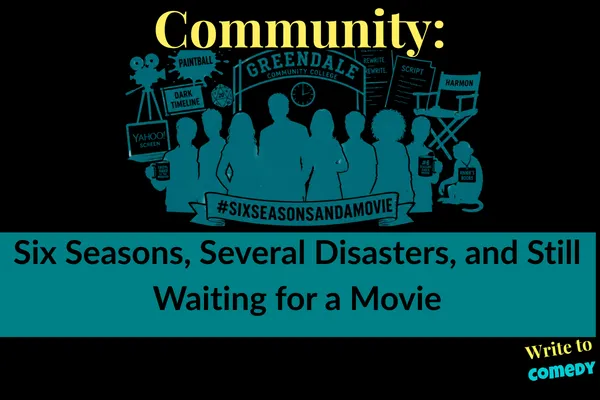
Community: Six Seasons, Several Disasters, and Still Waiting for a Movie
(Prefer to listen than scroll, here is the audio version of the post. Read by Jacquie Sarah, so expect warmth, humour, and maybe some mispronunciation)
NOTE: This post comes from my article, the Biggest Feuds in Sitcom History (you won’t believe number 7!!!)
No, that’s definitely not a WTC post. Not a chance. It was doing the research on the article, Do Sitcom Casts Really Like Each Other? What We Know, What We Assume, and Why It Matters, that made me realise there was a whole article to be written about Community. Here it is.
It is presented with the warning that I am compiling this from available interviews and articles. Surprisingly, I wasn’t there. I also have a lot of time for Community. Find your hit pieces elsewhere.
There are troubled television productions, and then there is Community.
The creator was sacked and rehired. One of its biggest stars fought with the creator and reportedly most of the cast. Episodes took ridiculous hours to make. It spent practically every season expecting to be cancelled, eventually was cancelled, then got rescued by Yahoo's attempt at becoming a television platform.
Yahoo's television platform did not survive.
Community did.
Perhaps the strangest thing about all of this is that the people who made it still seem to love it.
Joel McHale has been remarkably candid about how difficult Community could be to make. He's talked about the hours, Dan Harmon, Chevy Chase, and having to physically intervene with Chase. Yet McHale also remains one of the show's greatest cheerleaders and regularly talks about the long-promised movie. That's Community in a nutshell.
Making it could apparently be hell. They'd quite like to do it again.
Welcome to Greendale
Community began in 2009 with a relatively straightforward sitcom premise.
Jeff Winger, played by Joel McHale, is a lawyer who has been practising without the minor inconvenience of possessing a legitimate degree. Forced back into education, he enrols at Greendale Community College thinking it will be an easy ride, and creates a fake Spanish study group so he can get closer to Britta Perry, played by Gillian Jacobs.
Unfortunately for Jeff, other people turn up. Abed, Troy, Annie, Shirley, and Pierce join Jeff and Britta and the study group is born.
Initially, Jeff and Britta are clearly being positioned as the central romantic pairing. Then something interesting happened.
When Actors Ruin Your Plans
Joel McHale and Alison Brie had chemistry. Lots of it.
Jeff and Annie gradually became the romantic pairing audiences were encouraged to invest in, despite one fairly significant problem. Annie was eighteen.
McHale was approaching forty when Community began. Brie herself was in her late twenties, so the actors didn't have anything like the age difference of their characters. But Jeff and Annie did. The show knew it. Characters commented on it. Jeff knew it was inappropriate.
That doesn't make it entirely uncreepy.
It's also fascinating from a writing perspective because it demonstrates something Community did repeatedly. The writers discovered what worked and changed the programme around it.
Troy and Abed are another example. Donald Glover and Danny Pudi's chemistry transformed their characters into one of the show's defining friendships. Eventually we got Troy and Abed in the Morning, the imaginary television programme which apparently existed primarily because Troy and Abed found pretending to host a morning television programme enormously entertaining.
It shouldn't have been as funny as it was.
Troy and Abed in the moooorning.
Sorry.
Ken Jeong presented an even bigger problem.
In season one, Chang has a perfectly good reason to be at Greendale. He's the study group's Spanish teacher. Then he isn't. At which point the writers essentially spend five seasons answering the question: how can we keep Ken Jeong in this programme?
Chang becomes a student. He works in security. He attempts to take over Greendale. He gets Changnesia. Eventually the increasingly implausible reasons for Chang's presence become part of the joke. The character had become less important than the performer.
Community started with characters. Then it discovered its cast.
Streets Ahead. Occasionally Streets Behind.
For a programme capable of being extraordinarily clever, Community could also be remarkably juvenile about its female characters.
Annie and Britta mud wrestled over Jeff.
Britta was spanked.
Annie was frequently sexualised despite the programme repeatedly reminding us how young the character was.
Then there was Annie's Boobs. That was the name of the monkey. Yes, really. The joke is that Troy names the monkey after Annie's breasts. Then everybody continues calling it Annie's Boobs because apparently nobody could think of anything funnier over the following years.
Some elements of older sitcoms age badly because attitudes change. I'm not entirely convinced that one required the benefit of hindsight.
It makes Community an interesting contradiction. This was a programme capable of telling sophisticated stories about loneliness, friendship, identity, and neurodivergence, while sometimes treating its female characters as if it had suddenly been possessed by a teenage boy.
And the problems weren't confined to what appeared on screen.
Chevy Chase Has Left the Study Group
Chevy Chase was probably Community's biggest name when it launched. It did not go smoothly.
Chase became increasingly unhappy with Pierce Hawthorne and the direction the writers were taking him. His relationship with Harmon became particularly toxic, but problems developed with other members of the cast too. Things reached the entirely normal workplace situation where Harmon encouraged people at a wrap party to chant "Fuck Chevy" while Chase's wife and daughter were there. This is discussed in the documentary film I’m Chevy Chase, and You’re Not. A difficult but interesting watch.
Chase subsequently left Harmon an extremely angry voicemail. Harmon played it publicly.
There probably wasn't a LinkedIn Learning module covering this particular management technique.
McHale has subsequently talked openly about Chase's behaviour and about physically intervening during confrontations. Donald Glover has spoken about racist comments Chase directed towards him.
Chase eventually left during season four following another incident involving a racial slur. There is some context worth including: Chase was reportedly objecting to how racist Pierce was becoming and questioning where else the writers could possibly take the character. The language he chose to make that argument was obviously unacceptable.
It is one of several occasions in the history of Community where two things can be true at once. Chase could have had legitimate frustrations about Pierce.
And be extremely difficult to work with.
The Gas Leak Year
By then, Dan Harmon had already gone. Harmon's obsessive approach to Community helped make it extraordinary. It also helped make producing it extremely difficult.
Scripts could arrive late. Working hours became ridiculous. Harmon kept rewriting because he wanted things right, not merely finished. That passion extended to tiny details. Music mattered. When the production couldn't always afford the songs Harmon wanted, he was reportedly prepared to contribute his own money towards licensing.
That's the romantic version of creative perfectionism.
The less romantic version is everyone else still being at work at some ungodly hour because the script isn't finished. Eventually Sony had enough. Harmon was removed after season three, and David Guarascio and Moses Port took over.
Season four isn't terrible.
That's worth saying because Community fans sometimes talk about it as though NBC broadcast thirteen episodes of a test card. There are good episodes. There are funny moments. But something feels different.
When Harmon returned for season five, the show eventually explained the characters' strange behaviour the previous year.
There had been a gas leak.
Season four has been the Gas Leak Year ever since. Harsh, yes. Funny, also yes.
Dan Harmon and Megan Ganz
There is a danger in stories about difficult creative people that bad behaviour becomes part of the mythology.
He was impossible because he cared. She was demanding because she was brilliant. Everyone suffered but look at the art!
What happened between Harmon and Community writer Megan Ganz is why that argument needs challenging. Harmon developed feelings for Ganz while he was her boss. After she rejected him, his behaviour towards her changed. Ganz later described the effect it had on her confidence and career. Years later, Harmon publicly acknowledged what he had done.
Importantly, he didn't offer one of those celebrity apologies where nobody actually did anything, but everyone is terribly sorry that unspecified events may have caused offence. He admitted abusing his position and described his behaviour on his podcast Harmontown.
Ganz publicly accepted the apology and called it a masterclass in how to apologise.
That doesn't erase what happened. It does add another uncomfortable contradiction to Community's story.
Harmon created something beautiful. He could also behave badly towards the people helping him create it. Nobody is only the best thing they've ever done. Or the worst.
Somehow, They Made This
And this is the point where it would be very easy to turn the story of Community into a catalogue of dysfunction. Except look at what they actually made.
Modern Warfare transformed a community college into an action film.
Remedial Chaos Theory took the simple question of who should collect a pizza and created seven timelines, including the Darkest Timeline.
Abed's Uncontrollable Christmas turned the programme into stop-motion animation while telling a genuinely sad story about Abed's mother.
Cooperative Calligraphy made an entire episode about a missing pen.
There were documentaries, conspiracy thrillers, westerns, science fiction, Dungeons & Dragon, and episodes that seemed to change genre halfway through because somebody in the writers' room presumably asked, "Can we?" The answer was frequently yes.
Abed allowed the programme to acknowledge exactly what it was doing without quite breaking the fourth wall. He knew about bottle episodes. He understood character arcs. He recognised when life was following the conventions of television because television was how Abed understood life.
The clever part was that Community wasn't mocking sitcoms.
It loved them.
#Six Seasons...
Eventually, the cast started changing. Chevy Chase went. Donald Glover left during season five, and Community lost Troy and Abed. Yvette Nicole Brown left her regular role to care for her father. New characters arrived. Jonathan Banks joined. Paget Brewster and Keith David followed. The programme adapted because adaptation was what it had always done.
Every season seemed to come with rumours of cancellation until NBC finally did it after season five. And that should have been that. Except Community had accidentally written its own survival campaign years earlier.
Six seasons and a movie. It’s a line said by the character Abed in season 2, episode Paradigms of Human Memory. Fans followed and adopted #SixSeasonsAndAMovie, refusing to let the programme die. The final episode of season 3, Introduction to Finality, ended on the hashtag. The show was finally cancelled at the end of season five.
Then Yahoo Screen came calling.
Remember Yahoo Screen?
Exactly.
Yahoo rescued Community for a sixth season in 2015 as part of its attempt to compete in original streaming television.
The experiment didn't exactly go to plan. Yahoo Screen shut down the following year. Community had managed to outlive another home.
The series finale, Emotional Consequences of Broadcast Television, ended on a final hashtag.
#...And a Movie
The movie has now been talked about for so long that it has become difficult to distinguish an upcoming film from a timeline slip.
It was officially announced by Peacock in 2022. There is a script. There is money. Much of the cast is attached.
There are apparently just difficulties finding a point when people, including Donald Glover, Alison Brie, Joel McHale, Danny Pudi, Gillian Jacobs, Ken Jeong, and Jim Rash, are simultaneously free. Which is what happens when the cast of your frequently-nearly-cancelled sitcom go on to have successful careers.
Perhaps the reason people still care about the movie is the same reason the story behind Community is so interesting.
This was not a happy little production where everyone came to work, had a lovely time and went home at five. People behaved badly. People fell out. There were working practices that shouldn't be romanticised. There were creative decisions that look decidedly questionable now and, frankly, some that looked questionable then.
Yet somewhere inside all that chaos, a group of actors found something extraordinary together.
McHale still talks about it. The cast still reunites. They still want to play these people. And audiences still want to see them.
Maybe that's ultimately why Community survived everything thrown at it.
The programme was about a group of flawed people who arrived at Greendale for completely different reasons and somehow became a family. Behind the scenes, the people making it weren't perfect either.
But they created something beautiful.
Six seasons shouldn't really have happened.
The movie probably shouldn't happen either.
Which, given the history of Community, means there's every chance it will. And I can’t wait.
#SixSeasonsAndAMovie
What do you think? Let me know about clicking here.
You may also like:
Twenty-Five Years of The Office - The Sitcom That Changed Comedy Forever
Twenty-five years after its debut, discover why The Office changed television comedy forever, from David Brent to Tim and Dawn and its lasting influence.
Battle of the Comedies: British Precision vs American Heart
Sharp satire or warm hugs? From Fleabag to Frasier, here’s how British precision and American heart make sitcoms so different — and equally brilliant.
The Failure and Success of The Office (US) And What I (We) Can Learn From It
How The Office (US) went from flop to phenomenon — and what its messy, miraculous journey can teach us about creativity, failure, and finding your voice.